



© 2025 FilterCY
Submit an application
Fill the form and we will contact you as soon as possible
By clicking the Submit button, you agree to our Data Privacy
Find the right water filtration system in 1 minute.
Answer a few quick questions and get personalized recommendations for the best water filtration system for your home — with a discount: a drinking water filter, water softener, or whole-house filtration system.
How to Choose a Water Softener in Cyprus
Focus on the controller, not the cabinet
Choosing a water softener in Cyprus is almost always done incorrectly. People compare price, cabinet size, a nice-looking display, and whatever promises the salesperson makes. Then, a year later, they’re wondering why the system regenerates unpredictably, consumes too much salt, or fails to deliver consistent results.
In Cyprus, the selection logic should be different: first the technology type, then the controller, then the resin volume, and only at the very end the cabinet brand.
This is especially important on an island where water comes from multiple sources. Official sources indicate that desalination plants supply a significant portion of drinking water in many areas, while groundwater is often associated with increased salinity and elevated concentrations of certain ions in specific aquifers.
In other words, water composition can be inconsistent, and the system must operate predictably. (moa.gov.cy)
In Cyprus, the selection logic should be different: first the technology type, then the controller, then the resin volume, and only at the very end the cabinet brand.
This is especially important on an island where water comes from multiple sources. Official sources indicate that desalination plants supply a significant portion of drinking water in many areas, while groundwater is often associated with increased salinity and elevated concentrations of certain ions in specific aquifers.
In other words, water composition can be inconsistent, and the system must operate predictably. (moa.gov.cy)
Why Salt-Based Softeners Make Sense for Homes in Cyprus
If the goal is to actually make water soft throughout the entire house, and not just "reduce limescale a bit," then salt-based ion exchange softeners are the correct reference point.
Their operating principle is well established and transparent: a sodium-form cation resin exchanges sodium ions for calcium and magnesium ions, and is periodically regenerated with salt. DuPont describes in its technical guidance that sodium-form cation resin exchanges Na⁺ for Ca²⁺ and Mg²⁺, with regeneration determined by the amount of regenerant per cycle. This is exactly the case where you are not getting a vague "anti-scale effect," but a controlled and measurable hardness removal process.
In practice, this means something very simple: if the goal is to protect the boiler, faucets, showers, washing machine, dishwasher, plumbing, and tiles from constant limescale exposure, the right choice is not "some kind of filter," but a proper resin-based softener with salt regeneration.
In Cyprus, this is especially relevant because the problem is not theoretical. Homeowners are not dealing with abstract chemistry, but with scale buildup, stains, overheating heating elements, and accelerated appliance wear.
Their operating principle is well established and transparent: a sodium-form cation resin exchanges sodium ions for calcium and magnesium ions, and is periodically regenerated with salt. DuPont describes in its technical guidance that sodium-form cation resin exchanges Na⁺ for Ca²⁺ and Mg²⁺, with regeneration determined by the amount of regenerant per cycle. This is exactly the case where you are not getting a vague "anti-scale effect," but a controlled and measurable hardness removal process.
In practice, this means something very simple: if the goal is to protect the boiler, faucets, showers, washing machine, dishwasher, plumbing, and tiles from constant limescale exposure, the right choice is not "some kind of filter," but a proper resin-based softener with salt regeneration.
In Cyprus, this is especially relevant because the problem is not theoretical. Homeowners are not dealing with abstract chemistry, but with scale buildup, stains, overheating heating elements, and accelerated appliance wear.
In a Water Softener, the Controller Matters More Than the Cabinet
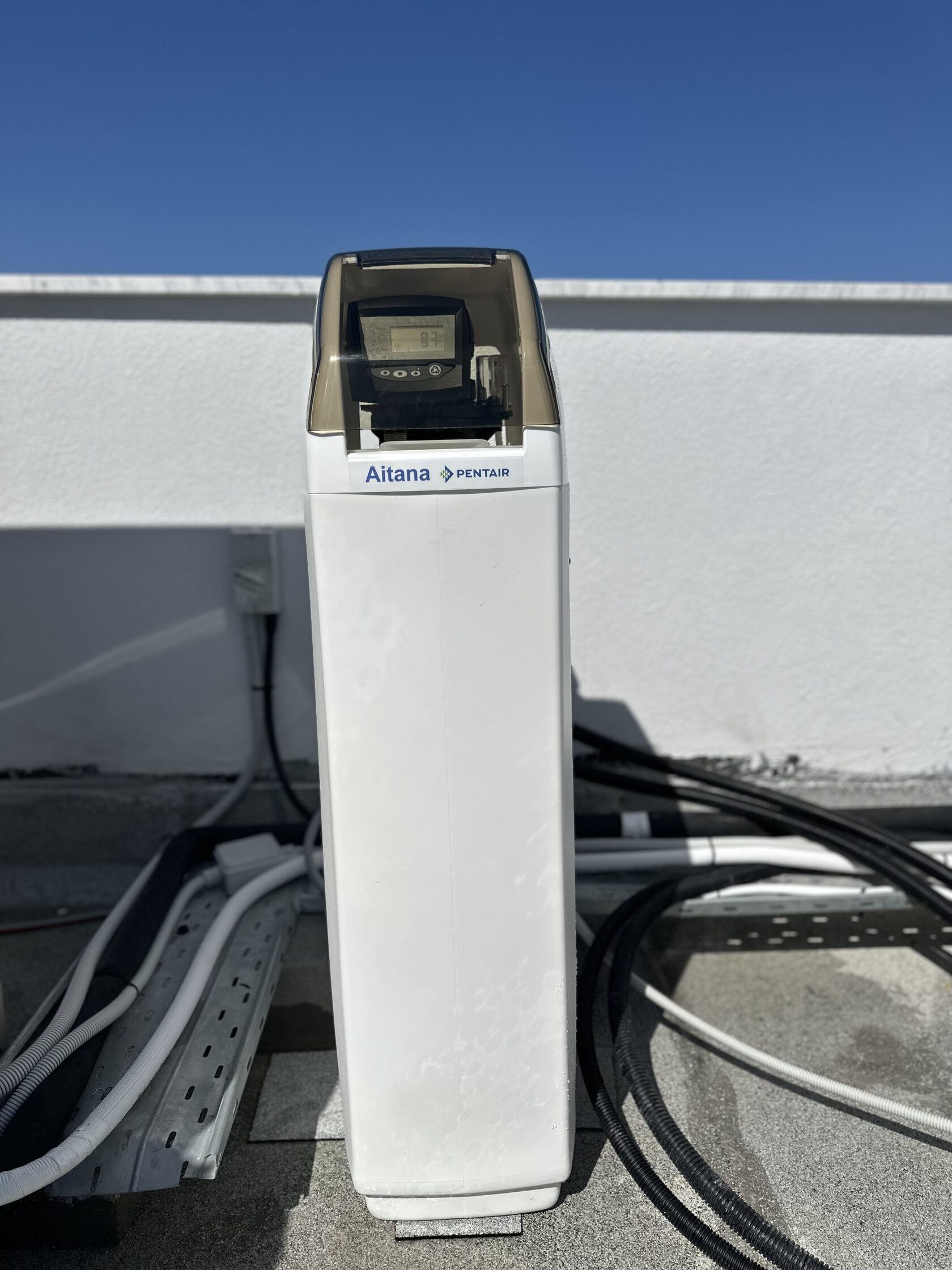
The single most important idea in this topic: in a water softener, the key component is not the tank, but the controller, i.e. the control valve.
The cabinet, brine tank, pressure vessel, and most of the hardware in residential systems are fairly standard. The real differences begin where the system has to calculate capacity, account for incoming water hardness, trigger regeneration at the right time, and correctly execute each cycle.
This is evident even in official documentation. Pentair technical manuals for softener platforms show that the controller operates with parameters such as incoming hardness, exchange capacity per litre of resin, resin volume, days between regenerations, cycle durations, regeneration mode, and reserve capacity. In Pentair IntelliWater, it is explicitly stated that resin volume is used to calculate capacity, while hardness and reserve are used to determine the usable volume between regenerations.
Documentation from Clack Corporation and Pentair also emphasizes that installation and servicing must be performed by qualified personnel, and that proper controller setup requires an understanding of water conditioning.
That’s why user complaints in real-world sources almost never sound like "the tank is плохой." Instead, they revolve around completely different issues:
— the system fails to draw brine
— the brine tank overflows
— regeneration happens at the wrong time
— water tastes salty after a cycle
— the system throws errors
— maintenance is required too frequently
In other words, the weak point of a residential softener is almost always in control logic, cycle management, and valve reliability, not in the color of the plastic housing.
The cabinet, brine tank, pressure vessel, and most of the hardware in residential systems are fairly standard. The real differences begin where the system has to calculate capacity, account for incoming water hardness, trigger regeneration at the right time, and correctly execute each cycle.
This is evident even in official documentation. Pentair technical manuals for softener platforms show that the controller operates with parameters such as incoming hardness, exchange capacity per litre of resin, resin volume, days between regenerations, cycle durations, regeneration mode, and reserve capacity. In Pentair IntelliWater, it is explicitly stated that resin volume is used to calculate capacity, while hardness and reserve are used to determine the usable volume between regenerations.
Documentation from Clack Corporation and Pentair also emphasizes that installation and servicing must be performed by qualified personnel, and that proper controller setup requires an understanding of water conditioning.
That’s why user complaints in real-world sources almost never sound like "the tank is плохой." Instead, they revolve around completely different issues:
— the system fails to draw brine
— the brine tank overflows
— regeneration happens at the wrong time
— water tastes salty after a cycle
— the system throws errors
— maintenance is required too frequently
In other words, the weak point of a residential softener is almost always in control logic, cycle management, and valve reliability, not in the color of the plastic housing.
Why Resin Volume Is So Important
The second fundamental factor after the controller is resin volume. It determines how much hardness the system can remove before the next regeneration.
This is directly reflected in Pentair programming logic: settings include exchange capacity per litre of resin and total resin volume. Other documentation states that resin volume and salt dosage are used to calculate total capacity, refill time, and the volume of treated water between regenerations.
So the math is simple. If two homes have the same water consumption and the same hardness, the system with less resin will exhaust its capacity faster and regenerate more often. And every regeneration means additional salt consumption, water usage, and wear on the system.
A smaller softener may be cheaper upfront, but not necessarily cheaper to operate.
This does not mean "the bigger the better." An oversized system costs more, takes up more space, and is not always justified for a typical apartment or moderate household. But undersizing, especially in Cyprus, is almost always a false economy.
This is directly reflected in Pentair programming logic: settings include exchange capacity per litre of resin and total resin volume. Other documentation states that resin volume and salt dosage are used to calculate total capacity, refill time, and the volume of treated water between regenerations.
So the math is simple. If two homes have the same water consumption and the same hardness, the system with less resin will exhaust its capacity faster and regenerate more often. And every regeneration means additional salt consumption, water usage, and wear on the system.
A smaller softener may be cheaper upfront, but not necessarily cheaper to operate.
This does not mean "the bigger the better." An oversized system costs more, takes up more space, and is not always justified for a typical apartment or moderate household. But undersizing, especially in Cyprus, is almost always a false economy.
Why 25–30 Litres of Resin Is a Good Benchmark for a Family of Four
For a typical family of four, 25–30 litres of resin is in most cases the most reasonable starting range. Not a strict rule, but rather a practical guideline. This volume usually provides a good balance between capacity, regeneration frequency, salt consumption, and system size.
When it makes sense to consider less than 25 litres: an apartment with moderate water consumption, one bathroom, seasonal living, no bathtub, no increased demand for hot water.
When it is worth considering 30 litres or more: two bathrooms, active use of showers and a bathtub, a large boiler, frequent laundry, high hot water consumption, a larger family, or very pronounced scaling based on water analysis.
The key point is this: the volume should not be chosen “by eye” or based on price, but based on a combination of three parameters — hardness, water consumption, and controller type. The same 25-litre softener can be an excellent solution in one home and too small in another.
When it makes sense to consider less than 25 litres: an apartment with moderate water consumption, one bathroom, seasonal living, no bathtub, no increased demand for hot water.
When it is worth considering 30 litres or more: two bathrooms, active use of showers and a bathtub, a large boiler, frequent laundry, high hot water consumption, a larger family, or very pronounced scaling based on water analysis.
The key point is this: the volume should not be chosen “by eye” or based on price, but based on a combination of three parameters — hardness, water consumption, and controller type. The same 25-litre softener can be an excellent solution in one home and too small in another.
Why Proper Installation Is Just as Important as the Softener Itself
Even the best valve can be ruined by improper installation. This is not theory. In the Pentair manual, it is clearly stated that the installer must understand water conditioning, be able to set correct control settings, and have proper plumbing skills. Documentation from Clack Corporation separately emphasizes that service and maintenance must be carried out by qualified personnel, and that the valve must not bear the weight of the pipeline. Translated into simple terms: if the system is installed “however it fits,” hardness is set randomly, and proper bypass, drain, and overflow are not implemented, what follows is no longer product comparison — it’s household-level horror. (pentair.com)
For Cyprus, this is especially important, because a real home setup often includes a roof tank, pump, boiler, a separate kitchen line, and sometimes additional protection against bacteria after the tank. That’s why installing a softener “somewhere after the water inlet” is a bad idea. First, you need to understand where the water enters, where the tank is located, where the pump is, whether a separate raw water line to the kitchen should be maintained, and whether an additional barrier like ultrafiltration is needed after the tank. Here are useful system layouts that can be used as a reference during design:
For Cyprus, this is especially important, because a real home setup often includes a roof tank, pump, boiler, a separate kitchen line, and sometimes additional protection against bacteria after the tank. That’s why installing a softener “somewhere after the water inlet” is a bad idea. First, you need to understand where the water enters, where the tank is located, where the pump is, whether a separate raw water line to the kitchen should be maintained, and whether an additional barrier like ultrafiltration is needed after the tank. Here are useful system layouts that can be used as a reference during design:
- Installation of a water softener and ultrafiltration system for filtering water from two sources: municipal water and well water
- Installation scheme of a water softener after a storage tank with a bypass line and drainage
- Installation of a water softener after a storage tank with a parallel line for a drinking water filter
- Installation of a water softener after a storage tank with a reverse osmosis filter
What to ask the seller before buying
If you do not want to choose at random, ask five simple questions:
Conclusion
If we summarize everything in one sentence, choosing a water softener in Cyprus looks like this:
- What controller is used here? Not "the system is smart," but specifically: Clack, Autotrol, or the brand’s own proprietary head.
- What is the regeneration logic? Volume-based or time-based. For a home, metered / volumetric regeneration is almost always better.
- How many liters of resin are inside? Not "suitable for a family," but the exact volume.
- What does the service look like? Who maintains the system, are spare parts available, and who will come if there is a valve error?
- What will the installation layout look like specifically in my house? This is especially important if you have a roof tank, pump, boiler, and separate kitchen.
Conclusion
If we summarize everything in one sentence, choosing a water softener in Cyprus looks like this:
- if you need truly soft water throughout the entire house, focus on a salt-based ion-exchange softener; (DuPont)
- when choosing a system, look first at the controller, because it controls hardness, capacity, regeneration, and serviceability;
- for a family of 4, 25−30 liters of resin is usually the most reasonable starting range;
- This is exactly how this topic should be understood: you are not choosing a "beautiful water softener," but a combination of technology, controller, resin volume, and proper installation. Everything else is secondary.
Comparison of Water Softeners Available on the Cyprus Market
If you do not want to dig into the details of each brand and controller separately, take a look at our water softener comparison table. It brings together the key differences, real advantages, and typical system issues in one place, so you can quickly understand which option fits your specific needs, rather than simply looking better on paper.
Unlock the Benefits of Soft Water
Experience the incredible feeling of silky-soft water on your skin
Learn more 