



© 2025 FilterCY
Submit an application
Fill the form and we will contact you as soon as possible
By clicking the Submit button, you agree to our Data Privacy
Find the right water filtration system in 1 minute.
Answer a few quick questions and get personalized recommendations for the best water filtration system for your home — with a discount: a drinking water filter, water softener, or whole-house filtration system.
Installation of a water softener after a storage tank with a reverse osmosis filter
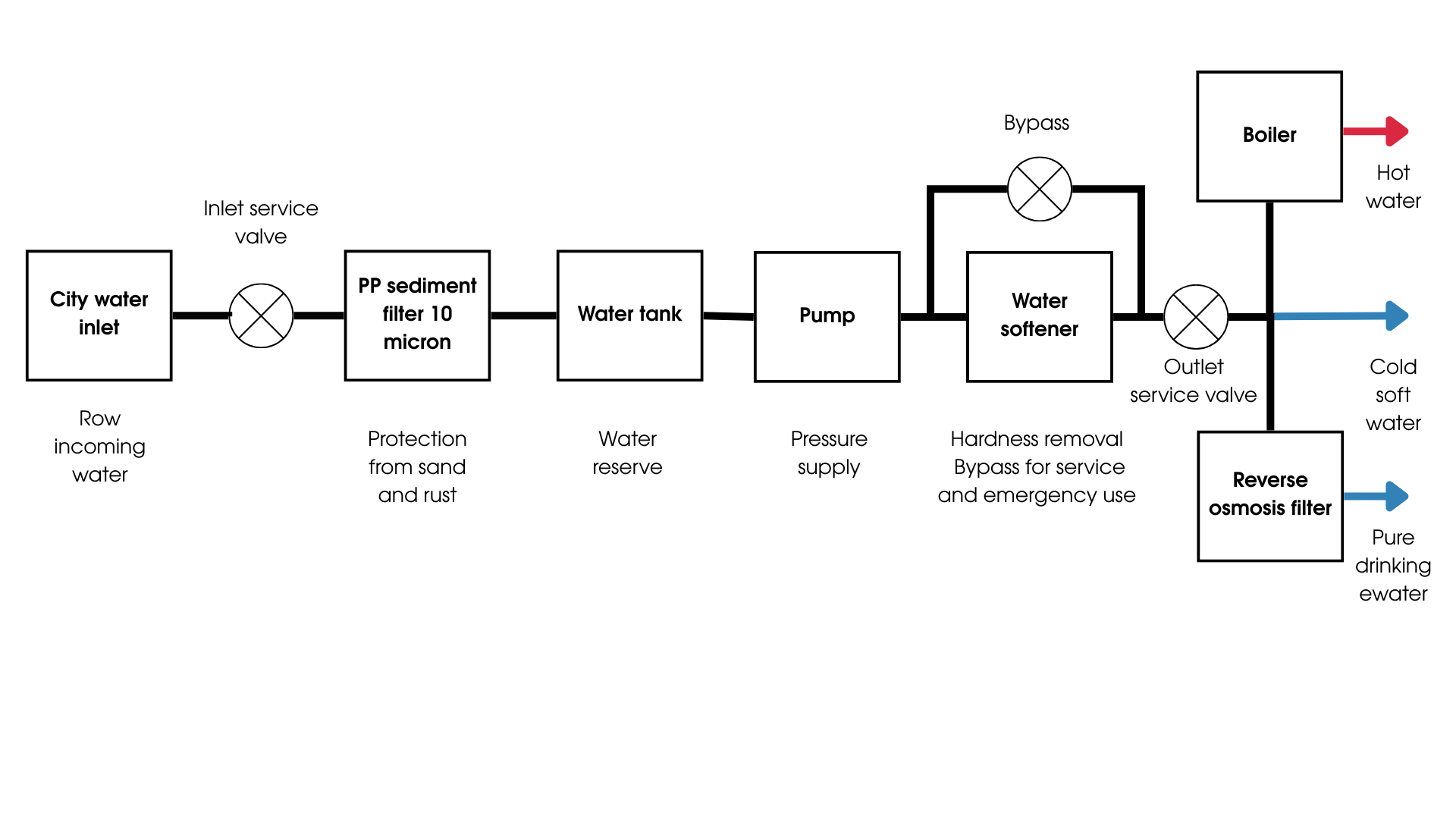
This scheme shows the installation of a water softening system after a storage tank and pump, where all water in the house first passes through the softener, and the reverse osmosis filter is connected after the softening system to obtain purified drinking water.
This configuration allows protecting household appliances and the boiler from limescale, as well as extending the lifespan of the reverse osmosis membrane by предварительного удаления hardness salts.
This configuration allows protecting household appliances and the boiler from limescale, as well as extending the lifespan of the reverse osmosis membrane by предварительного удаления hardness salts.
Installation scheme of a water softener after a storage tank with a reverse osmosis filter
Author: Filter.cy Engineers
Expertise: water treatment and water filtration systems
Updated: March 2026
Expertise: water treatment and water filtration systems
Updated: March 2026
In this configuration, municipal water first enters the house water supply system and passes through a mechanical filter. The filter removes sand, rust, and other mechanical impurities, protecting the storage tank and pump.
After that, the water enters a rooftop storage tank, where a reserve of water for the house is created.
The pump supplies water from the tank to the water system under stable pressure.
At the next stage, the water passes through the softening system. The softener removes hardness salts of calcium and magnesium, preventing limescale formation in the boiler, household appliances, and pipelines.
After the softening system, the water flow is split:
After that, the water enters a rooftop storage tank, where a reserve of water for the house is created.
The pump supplies water from the tank to the water system under stable pressure.
At the next stage, the water passes through the softening system. The softener removes hardness salts of calcium and magnesium, preventing limescale formation in the boiler, household appliances, and pipelines.
After the softening system, the water flow is split:
- one line supplies softened water to the house cold water system
- another line supplies water to the boiler for hot water production
- an additional line is directed to the reverse osmosis filter to obtain drinking water
water flow logic
City water inlet
↓
PP sediment filter
↓
Water tank (roof)
↓
Pump
↓
Water softener
↓
Split flow
├─ Boiler → Hot water
├─ Cold water → House
└─ Reverse osmosis filter → Drinking water
City water inlet
↓
PP sediment filter
↓
Water tank (roof)
↓
Pump
↓
Water softener
↓
Split flow
├─ Boiler → Hot water
├─ Cold water → House
└─ Reverse osmosis filter → Drinking water
Step-by-step algorithm
- Municipal water enters the system through the main water inlet to the house.
- The inlet service valve allows shutting off the water for system maintenance.
- The 10-micron mechanical filter removes sand, rust, and mechanical contaminants.
- The water enters the storage tank, where a reserve of water for the house is created.
- The pump supplies water from the tank to the water system under pressure.
- After the pump, the water enters the softening system.
- The softener removes hardness salts of calcium and magnesium.
- The bypass line allows water to be supplied bypassing the softener during maintenance.
- After the softener, the water is split into several flows.
- One flow is supplied to the boiler for hot water production.
- The second flow is supplied to the house cold water system.
- The third flow is directed to the reverse osmosis filter to obtain drinking water.
When this scheme is used
This scheme is used in the following cases:
- the house uses a rooftop storage tank
- water is supplied to the house by a pump
- protection of the boiler and appliances from limescale is required
- installation of a reverse osmosis system for drinking water is planned
- it is necessary to increase the lifespan of the reverse osmosis membrane
Key advantages of the scheme
- protection of household appliances and the boiler from limescale
- soft water throughout the entire water supply system
- increased lifespan of the reverse osmosis membrane
- stable operation of the drinking water filter
- convenient system maintenance via bypass
Unlock the Benefits of Soft Water
Experience the incredible feeling of silky-soft water on your skin
Learn more Components and their functions
FAQ
The softener replaces hardness salts — calcium and magnesium — with sodium ions. As a result, water after the softener contains almost no calcium and magnesium, while sodium levels are higher.
Such water is well suited for household use because it does not form scale in boilers, washing machines, and pipes. However, for drinking water this composition is not considered optimal, as it contains more sodium and lacks natural minerals like calcium and magnesium.
That is why a reverse osmosis filter is installed after the softener to produce high-quality drinking water. RO removes dissolved salts and other impurities, after which the water can be additionally remineralized to achieve a comfortable and safe composition for drinking.
Such water is well suited for household use because it does not form scale in boilers, washing machines, and pipes. However, for drinking water this composition is not considered optimal, as it contains more sodium and lacks natural minerals like calcium and magnesium.
That is why a reverse osmosis filter is installed after the softener to produce high-quality drinking water. RO removes dissolved salts and other impurities, after which the water can be additionally remineralized to achieve a comfortable and safe composition for drinking.
Yes, if the plumbing allows it. This option is often preferable, as water from the storage tank can stagnate.
No. Drinking water undergoes additional purification through the reverse osmosis system.
No. In this configuration, the drinking water filter is connected to a separate raw water line, so the softener does not affect it.
Because water from the tank is supplied by a pump under stable pressure, which is necessary for the correct operation of the softener control valve.
Similar connection schemes
Optimal Water Filtration and Softening System for Houses and Apartments in Cyprus
Installation Layout of a Water Softener, Ultrafiltration System, and Reverse Osmosis System
Water Treatment Scheme from Two Sources: Well and Municipal Water in Cyprus
Installation Scheme of a Water Softener, Ultrafiltration System, and UV Lamp for the Treatment, Softening, and Disinfection of Water from a Well and Municipal Supply
How to install a water softener in an apartment in Cyprus
Installation scheme of a water softener after a storage tank: correct connection, bypass, and service valves. Learn how the system should operate.
Installation scheme of a water softener after a storage tank with a drinking water filter
Installation scheme of a water softener after a storage tank with a parallel line for a drinking water filter. Detailed description, system components, and operating principle.
Have a questions? Message us!
Recommended components for this configuration
BWT Water Softener 30L CLACK WS1CI
SKU: 700.954.29
€
1200
€
1350
The BWT 30L Water Softener, equipped with the state-of-the-art Clack WS1CI valve, is the best water softener system for tackling hard water issues common in Cyprus. This system effectively reduces limescale buildup, protecting your appliances and improving the efficiency of heating systems. With a 30-liter resin capacity, it delivers a service flow rate of up to 1,000 liters per hour, ensuring a steady supply of softened water for medium-sized households. The Clack WS1CI valve offers precise control over regeneration cycles, optimizing salt and water usage for cost-effective and sustainable operation. Its compact design allows for easy installation in any home. Upgrade to the BWT 30L Water Softener and enjoy the ultimate solution for combating hard water in Cyprus while enhancing your home’s comfort and efficiency.
Ecosoft CROSS 60 Direct Flow RO
€
500
€
Ecosoft CROSS 60 is a direct flow reverse osmosis system without a storage tank, designed to provide a continuous supply of purified water at up to 60 liters per hour. Water is delivered immediately after filtration, without storage, eliminating stagnation and unwanted taste.
The system removes up to 99% of contaminants, including chlorine, heavy metals, bacteria, and organic compounds. Thanks to direct flow technology, you get consistent pressure and fast water delivery instead of the slow trickle typical of conventional systems.
The system also includes modern safety and control features:
The system removes up to 99% of contaminants, including chlorine, heavy metals, bacteria, and organic compounds. Thanks to direct flow technology, you get consistent pressure and fast water delivery instead of the slow trickle typical of conventional systems.
The system also includes modern safety and control features:
- leak protection
- automatic membrane flushing
- stable operation under pressure fluctuations
- energy-efficient pump
Examples of completed projects
Useful links
Can You Drink Tap Water in Cyprus?
Learn about the quality of tap water in Cyprus, potential risks, and the best purification methods, including the effectiveness of reverse osmosis.
Water Purification and Disinfection Methods
Discover how to effectively purify and disinfect water at home. Mechanical filtration, carbon filters, reverse osmosis, and UV treatment for safe water.
Soft and Hard Water
Learn the differences between soft and hard water, their benefits, and risks. How to address water hardness and choose the best filtration and softening system for your home.
Disadvantages of Home Reverse Osmosis Systems
Discover the key drawbacks of reverse osmosis systems and explore their benefits, making this technology the best choice for clean water in your home.
Rent a Water Filter in Cyprus – Pure Water, No Upfront Costs
Get clean, safe water with our hassle-free rental plans. No large investments, just pure convenience! Maintenance included.
Hard Water in Cyprus: Why It’s a Problem and How to Tackle It
Discover how hard water in Cyprus affects appliances, pipes, skin, and hair, and what can be done to soften the water.
Water Softener Types: A Comprehensive Guide
Learn about different types of water softeners – salt-based, salt-free, magnetic, and electromagnetic – and choose the best one for your needs.
How Drought Impacts Tap Water Quality & Why Water Filtration Matters
Discover how drought affects tap water quality, increasing contaminants and chlorine levels. Learn how filtration can keep your water clean and safe
How to Choose a Water Softener in Cyprus — Complete Guide 2026
How to choose a water softener in Cyprus: salt-based systems, resin volume, controller selection, and installation layouts. A practical guide for your home.
Water Softener Comparison in Cyprus — Which One to Choose in 2026
Comparison of water softeners in Cyprus: Clack, Autotrol, WaterBoss, Aquaphor, and others. Pros, cons, real-world issues, and practical advice on choosing a system for your home.
Ready to start?
Fill the form and we will contact you
